
Contents
- 1. How Resilient Leaders Stay Sane in a Volatile Age
- 2. The Emotional Cost of Invisible Risk
- 3. AI Models Are Not Strategy
- 4. Building a Stack You Can Walk Away From
- 5. Leadership in the Age of Vanishing Tools
- 6. Protecting Your People from the Coming Price Storm
- 7. From Fragile Reliance to Confident Adaptation
How Resilient Leaders Stay Sane in a Volatile Age
If you lead a business today, there’s a quiet truth you’re already feeling in your gut:
You are building your strategy on tools you don’t control, priced by companies you don’t influence, governed by policies you didn’t vote on.
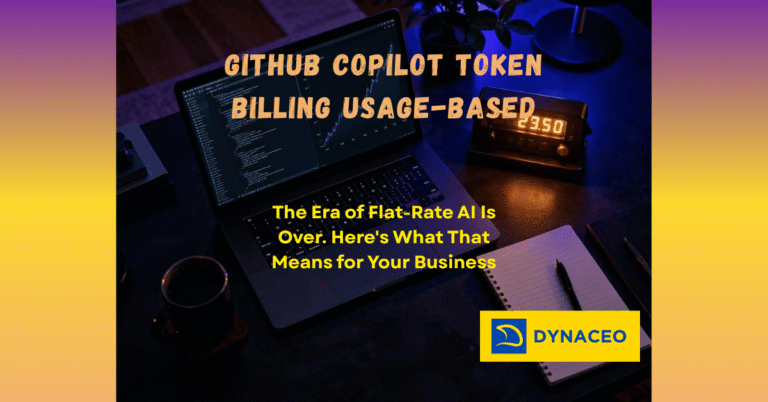
Last year’s “unlimited” AI suddenly has a meter. Your favorite model can be throttled, repriced, or rolled back overnight. Competitors can ship something that looks like magic in a weekend—and lose it just as fast.
It’s tempting to shrug and say, “That’s just how technology works.”
But for leaders, this isn’t a technical footnote. It’s a question of resilience, responsibility, and what kind of future you’re actually building.
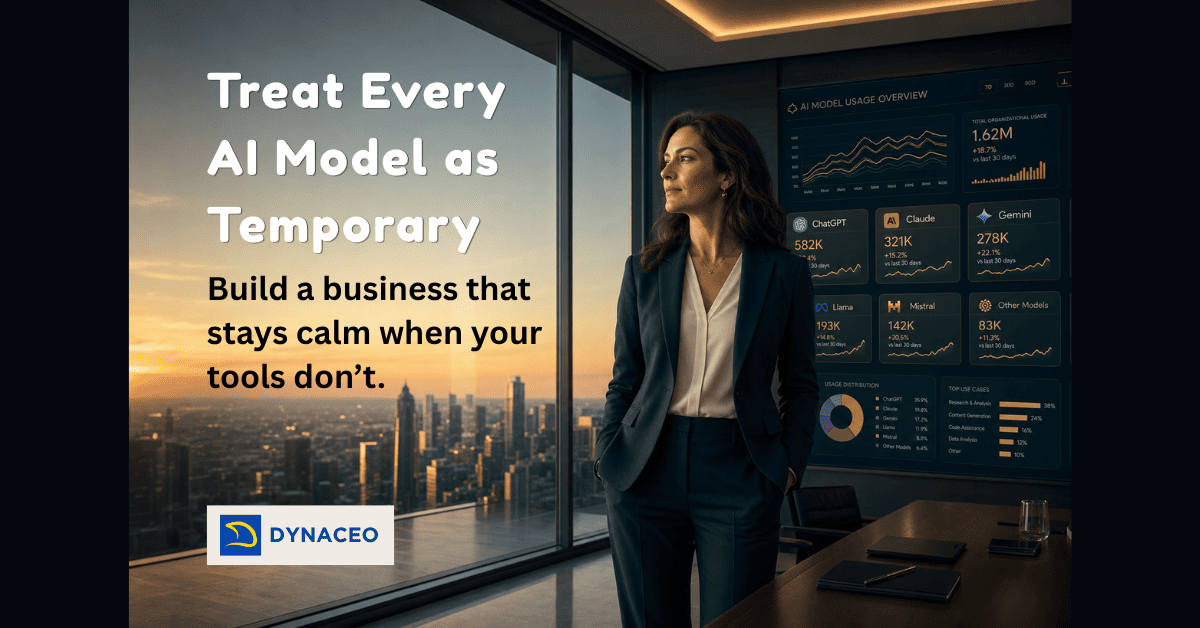
At Dynaceo, we believe tomorrow’s strongest organizations won’t be the ones with the shiniest model. They’ll be the ones who treat every model as temporary—and still sleep at night.
The Emotional Cost of Invisible Risk
Executives often talk about “risk” in abstract terms: exposure, volatility, downside scenarios. What rarely gets named is the emotional weight of depending on something you don’t truly understand or control.
You feel it when:
Your team quietly worries that a single API key underpins half your roadmap.
Your board asks, “What happens if this vendor doubles prices?” and the room falls silent.
Your best people are suddenly spending their weekends rewriting workflows because a model changed its behavior.
That weight shows up as anxiety, firefighting, and a low-grade sense that you’re always catching up. It doesn’t just hurt your margins; it erodes trust in the future you’re trying to sell—to your customers, your investors, and your own people.
Naming that feeling matters. Because once you see the emotional cost of fragile dependencies, you’re more willing to do the hard, sometimes unglamorous work of building resilience.
AI Models Are Not Strategy
It’s easy to confuse “we use cutting-edge AI” with “we have a winning strategy.”
They’re not the same.
AI models are becoming commodities. Their relative performance changes every few weeks. What feels like a breakthrough today can be table stakes—or obsolete—by your next planning cycle.
If your story is “we’re better because we use Model X,” you don’t have a strategy. You have a timing advantage.
Real strategy sounds different:
“We can swap models in a week without breaking our experience.”
“Our value comes from the data, workflows, and trust we’ve built around the models, not from the models themselves.”
“We assume every tool we use can vanish, and we’ve designed for that reality.”
When you think that way, models stop being a source of existential fear and start becoming what they should be: powerful, temporary tools in a much larger design.
Building a Stack You Can Walk Away From
Resilient leaders ask a simple but uncomfortable question:
“If this model disappeared on Monday, how much of my business would still work by Friday?”
If the honest answer is “not much,” you don’t need another AI experiment. You need a portability agenda.
That agenda doesn’t have to be flashy. It looks like:
Abstractions instead of hard-coded loyalties: You design your systems so that the rest of your stack talks to an internal “AI service,” not directly to one vendor’s API. Swapping a model becomes a controlled operation, not a crisis.
Data you truly own: You treat your data—customer history, domain expertise, operational patterns—as your moat. Models come and go; your data, if curated and governed well, keeps compounding.
Graceful degradation: You define “good enough” fallbacks. If the top-tier model is unavailable or too expensive, your product doesn’t just fail. It downgrades intelligently while preserving trust.
This is not about paranoia. It’s about dignity. You are choosing to run a business that can breathe, even when the market stops cooperating.
Leadership in the Age of Vanishing Tools
Technology teams can implement abstraction layers and monitoring. Finance teams can renegotiate contracts and model price scenarios. But true resilience starts with how leaders think and communicate.
Three simple shifts make a profound difference:
First, you normalize change instead of dramatizing it.
When a model is deprecated or repriced, you don’t treat it as a betrayal. You treat it as expected turbulence. The question isn’t “How could they do this?” but “How quickly do we adapt, and what do we learn?”
Second, you reward resilience, not just speed.
You celebrate teams that ship fast—but also teams that quietly build fallback paths, document decisions, and design for portability. In the short term, those choices look slower. In a shock, they look visionary.
Third, you tell a bigger story than “we’re an AI company.”
Your people need to hear, again and again, that the heart of your business is not a model name. It’s the problem you exist to solve, the customers you serve, and the values that won’t change when the tools do.
That story steadies people. It gives them permission to be curious about new models without being owned by them.
Protecting Your People from the Coming Price Storm
There is another quiet risk: the expectation that AI will always be cheaper, faster, and simpler than humans.
Some companies are already discovering the opposite. Flat-rate tools become metered. Usage soars. Bills spike. What looked like a cost-saving strategy suddenly feels like a trap.
Underneath the spreadsheets, there are human consequences:
Teams pushed to replace judgment with prompts, then blamed when outcomes are fragile.
Employees told they’re “too expensive” compared to tools whose real cost hasn’t fully landed yet.
Leaders waking up to the realization that they’ve traded stable payroll for unstable platform dependency.
Resilient leadership doesn’t romanticize humans or demonize AI. It does something harder: it defends the right mix.
You protect roles where human nuance, ethics, and long-term relationships truly matter—and you use AI to augment them, not erase them. You track not just what AI “saves,” but what it adds to your risk profile and your ability to respond under pressure.
In other words, you make sure the invoices of tomorrow don’t undermine the culture you’re trying to build today.
From Fragile Reliance to Confident Adaptation
Treating every AI model as temporary is not an admission of defeat. It’s an act of leadership.
It says:
“We will use the best tools available today, without becoming dependent on any single one.”
“We will design our systems, contracts, and culture around resilience, not wishful thinking.”
“We will measure our success not just by how quickly we adopt AI, but by how gracefully we adapt when it changes.”
At Dynaceo, we exist for leaders who feel that tension every day—the pull between urgency and wisdom, innovation and stability, ambition and responsibility.
The tools will keep changing. The invoices will keep surprising. The headlines will keep swinging between hype and fear.
Your job is not to predict every twist.
Your job is to build an organization that can take a deep breath, absorb the shock, and keep moving with clarity.
That is the real work of tomorrow’s leadership. And it starts with a simple decision:
Use every model boldly.
Need none of them to be okay.